
What is a registered office (domiciliation) in France?
A registered office (domiciliation) in France is the official legal address of a company, recorded at the commercial court registry and used for all administrative and legal correspondence. This address appears on invoices, contracts, the Kbis extract and every filing with the French authorities. Under Article L123-11 of the French Commercial Code, no company can be registered in France without declaring one.
The registered office fixes several legal points. It determines the competent commercial court (tribunal de commerce), the tax office in charge of your file and the applicable local business tax (CFE). For a foreign company opening a subsidiary or a branch, this address is the anchor point of its French existence.
The term “domiciliation” refers specifically to the service of providing that address, usually through a licensed domiciliation company (société de domiciliation) approved by the préfecture. Keypoint works with foreign companies to choose an address that matches their real activity in France, avoiding the mismatch between a paper address and where business actually happens. That distinction matters: French registries and banks increasingly check the substance behind an address.
Article L123-11
French Commercial Code provision requiring every registered company to declare a valid business address (Légifrance, 2024)
Why is a registered office mandatory for foreign companies in France?
A registered office is mandatory for foreign companies in France because no legal entity can be entered in the national business register (RNE) without a declared French address. Whether you set up a subsidiary (filiale) or a branch (succursale), the registry needs a physical point of contact in France to process your file (INPI, 2024).
The address serves three concrete functions. First, it receives official mail from the tax authorities, URSSAF and the commercial court. Second, it fixes your tax jurisdiction, including the CFE local business tax that every French establishment pays. Third, it gives clients, suppliers and banks a verifiable location, which speeds up opening a professional bank account.
For a foreign parent company, the choice between a subsidiary and a branch changes the legal weight of that address. Keypoint regularly advises groups from the Netherlands, Canada and Asia on this decision, and detailed guidance on the two structures is available on our page dedicated to subsidiary or branch creation in France. A branch keeps the legal personality of the foreign parent; a subsidiary is a separate French company. In both cases, the French address is non-negotiable.
À retenir
- No registration in the French RNE is possible without a declared address (INPI, 2024)
- The address fixes the tax office and the CFE local business tax for the company
- A domiciliation contract must run for at least 3 months, renewable by tacit agreement (Article R123-168, Commercial Code)
What are the registered office options in France?
Foreign companies in France have four main registered office options: a licensed domiciliation company, rented commercial premises, a coworking or business centre, or the legal director’s private home. Each option meets the legal requirement but differs on cost, image and flexibility.
A domiciliation company (société de domiciliation) is the most common choice for foreign businesses starting out. These providers hold a préfecture licence and offer a prestigious address plus mail handling. Renting commercial premises gives full control and physical space but ties you to a lease, often a 3-6-9 commercial lease under French law. Coworking spaces and business centres sit in between, offering an address with meeting rooms on demand.
Using the director’s home is possible but limited. If the director is a tenant or the building rules forbid business use, the domiciliation may only last five years (Article L123-11-1, Commercial Code). For a foreign director rarely present in France, this option rarely holds up. Keypoint helps clients weigh these choices against their real presence in France, then organises the follow-up through our registered office and administrative assistance service.

| Criterion | Domiciliation company | Commercial lease | Director’s home |
|---|---|---|---|
| Typical monthly cost | €20 to €150 | €500 and up | Low or none |
| Physical space | Optional | Yes | No dedicated space |
| Duration limit | Min. 3-month contract | Usually 9 years | Max. 5 years if tenant |
| Fit for foreign directors | High | Medium | Low |
How much does domiciliation cost in France?
Domiciliation in France costs between €20 and €150 per month for a standard registered office through a licensed provider, depending on the city and services included. A prestige address in central Paris sits at the top of that range, while a regional business address can be found under €30 per month (French domiciliation market data, 2025).
The base price covers the legal address and its use on official documents. Add-on services raise the cost: mail forwarding, phone answering, meeting room access and scanning of incoming post. For a foreign company, mail handling is often the deciding factor, since letters from URSSAF or the tax office cannot be missed.
Beyond the domiciliation fee, budget for the CFE local business tax, which every French establishment pays from its second year and varies by commune. Keypoint builds a full cost picture for foreign clients, combining the address with accounting and financial statements support so the recurring charges are clear from day one. Hidden costs usually come from add-ons bought separately rather than the address itself.
Base address
€20 to €150 per month depending on city and prestige (2025 market range)
Mail handling
Forwarding and scanning often added at €10 to €40 per month
CFE tax
Local business tax due from year two, set by each French commune
How do you set up a registered office in France step by step?
Setting up a registered office in France follows five steps: choose the address type, sign the domiciliation or lease contract, gather the required documents, file the registration with the INPI one-stop shop, then receive the Kbis extract. The process usually takes one to three weeks once documents are ready (INPI, 2024).
- Choose the address type. Decide between a domiciliation provider, a lease, a business centre or the director’s home based on your real presence in France.
- Sign the contract. A domiciliation contract must last at least three months and name the licensed provider (Article R123-168, Commercial Code).
- Gather documents. Foreign shareholders need identity documents, the parent company’s registration certificate and translated statutes where required.
- File the registration. Since January 2023, all company formalities go through the INPI guichet unique online portal.
- Receive the Kbis. The commercial court issues the Kbis extract, the official proof that your company exists at its French address.
Foreign companies often stumble on translated and apostilled documents, which the registry requires for non-EU parent entities. Keypoint prepares these files for clients from Canada, Asia and the Americas, coordinating with the legal advice and assistance team so a missing certificate does not delay the whole registration in France.
Common mistakes foreign companies make with domiciliation
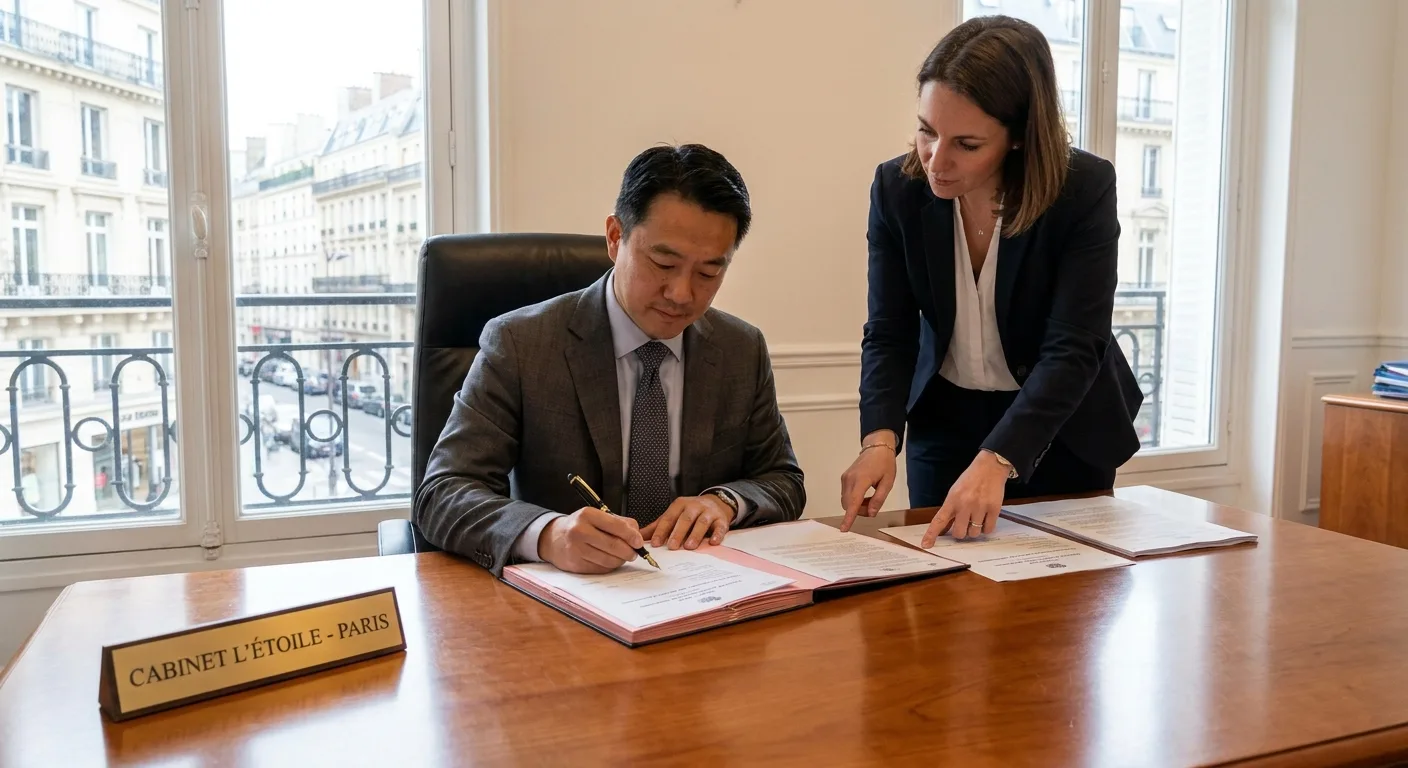
The most common domiciliation mistakes foreign companies make in France are using an address with no real substance, missing official mail, and ignoring the CFE tax tied to the location. Each of these can trigger a rejection, a tax reminder or a frozen bank account.
Substance is the first trap. A registered office at an address where no activity, staff or decision-making exists can be challenged by the tax authorities and by banks during account opening. French banks increasingly ask for proof of genuine local presence before approving a professional account (Banque de France context, 2024).
Missed mail is the second. Letters from URSSAF, the tax office or the commercial court carry deadlines. A foreign director who is rarely in France and has no mail-forwarding arrangement can lose a payment window without ever seeing the letter. The third mistake is treating the address as a one-off decision, forgetting the CFE local tax and the annual filings that follow.
Keypoint prevents these issues by pairing the registered office with ongoing administrative and tax compliance support in France. According to the French statistics institute, foreign-controlled companies employed several million people in France, which shows how routine cross-border setups are when handled correctly (Insee, 2023). The address is only the start of the relationship with the French administration.
How does Keypoint support foreign companies with domiciliation?
Keypoint supports foreign companies with domiciliation by selecting a compliant French registered office, handling the registration file, and managing the mail and administrative duties that follow. As a chartered accountancy and advisory firm focused on international businesses, Keypoint treats the address as part of a full setup, not an isolated service.
The support covers three phases. Before registration, Keypoint advises on the address type that fits your real presence and prepares the translated and certified documents that non-EU parent companies must submit. During registration, the team files everything through the INPI one-stop shop and follows up until the Kbis extract is issued. After registration, Keypoint receives official mail, flags deadlines and coordinates accounting, payroll and tax filings.
This continuity matters for foreign directors who cannot be in France every week. Rather than juggling a domiciliation provider, an accountant and a lawyer separately, clients work with one firm. Keypoint also connects the registered office to payroll and HR consulting when the company starts hiring in France. The official framework for company formalities is published by the French administration on the service-public.fr business portal, and Keypoint keeps clients aligned with those rules as they evolve.
Ce que disent nos clients
Keypoint holds a verified rating of 5.0/5 based on 5 client reviews. Several of them concern foreign companies setting up in France.
”Cabinet très professionnel, à l’écoute et réactif. Un accompagnement de grande qualité, notamment pour l’implantation de notre structure en France. Un grand merci à David pour ses précieux conseils.”
— Charles★★★★★ 5/5
”Travailler avec ce cabinet comptable a été une expérience très positive pour notre entreprise. L’équipe est non seulement compétente et réactive, mais également très à l’écoute. Leurs conseils clairs et précis nous ont aidés à avancer en toute confiance, et leur accompagnement personnalisé fait vraiment la différence. Je recommande ce cabinet à toute structure, grande ou petite, qui cherche un partenaire de confiance.”
— Sera DUFOI GUDENYAN★★★★★ 5/5
”Très satisfait de l’accompagnement du cabinet. L’équipe est professionnelle, réactive et toujours à l’écoute. Les conseils sont clairs, pertinents et nous aident à prendre les bonnes décisions pour développer notre activité. Un partenaire fiable que je recommande sans hésitation.”
— Dr Morgan CHICHEPORTICHE★★★★★ 5/5
”Excellente expérience avec ce cabinet. L’équipe est agréable, à l’écoute, compétente et surtout, réactive ! Satisfaction totale Je recommande vivement”
— Raphaelle E★★★★★ 5/5
”Apres de nombreuses déceptions…J’ai été très sensible à l’accueil ,et l’écoute de ce Cabinet qu’on m’avait recommandé qui m’a soutenu dans l’aboutissement de mon projet”
— laurent paris★★★★★ 5/5